Daily 10 - Feb 18
Class Performance
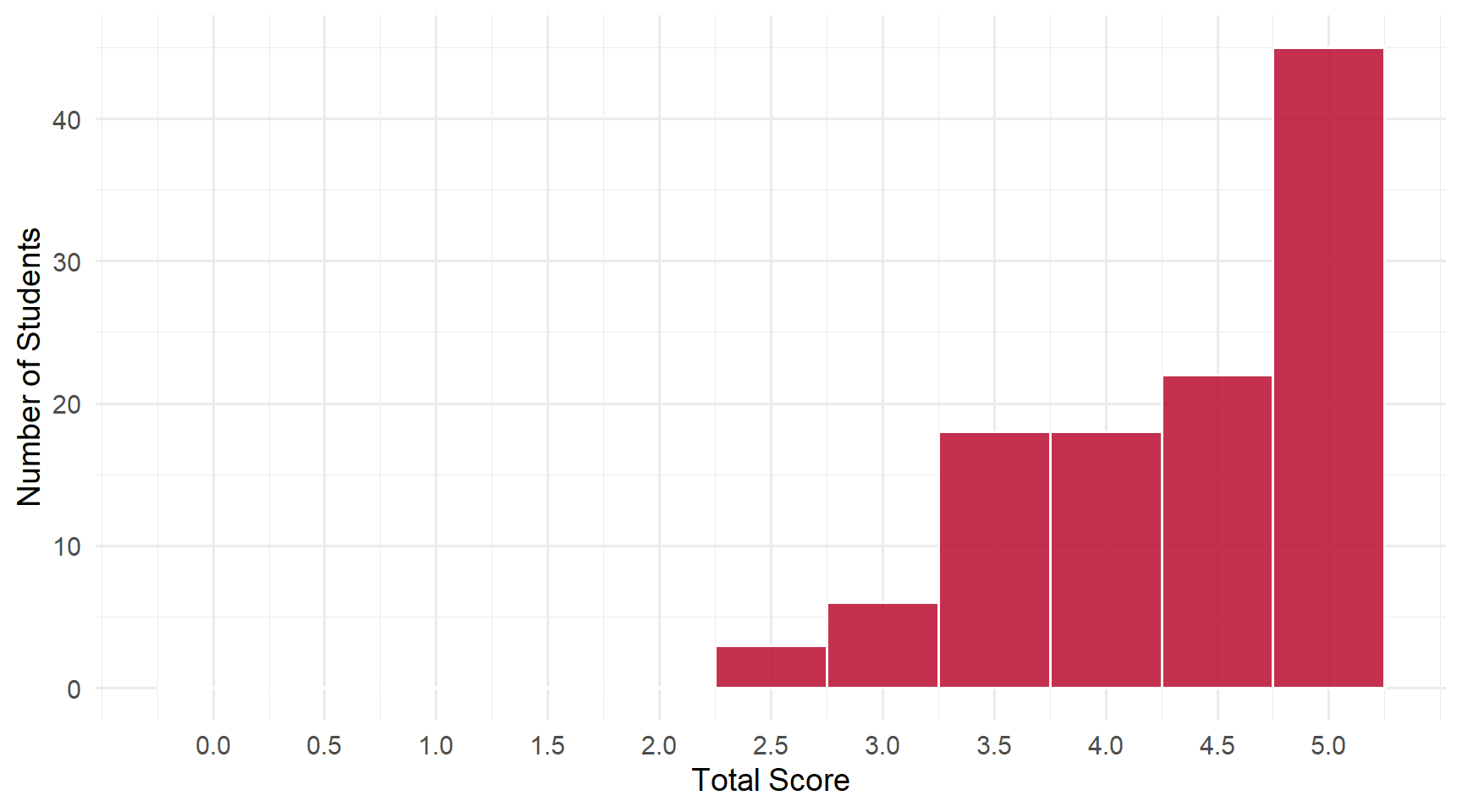
Students: 112 | Mean: 4.33 | Median: 4.5 | SD: 0.71
Scores ranged from 2.5 to 5 out of 5 points.
Score Distribution
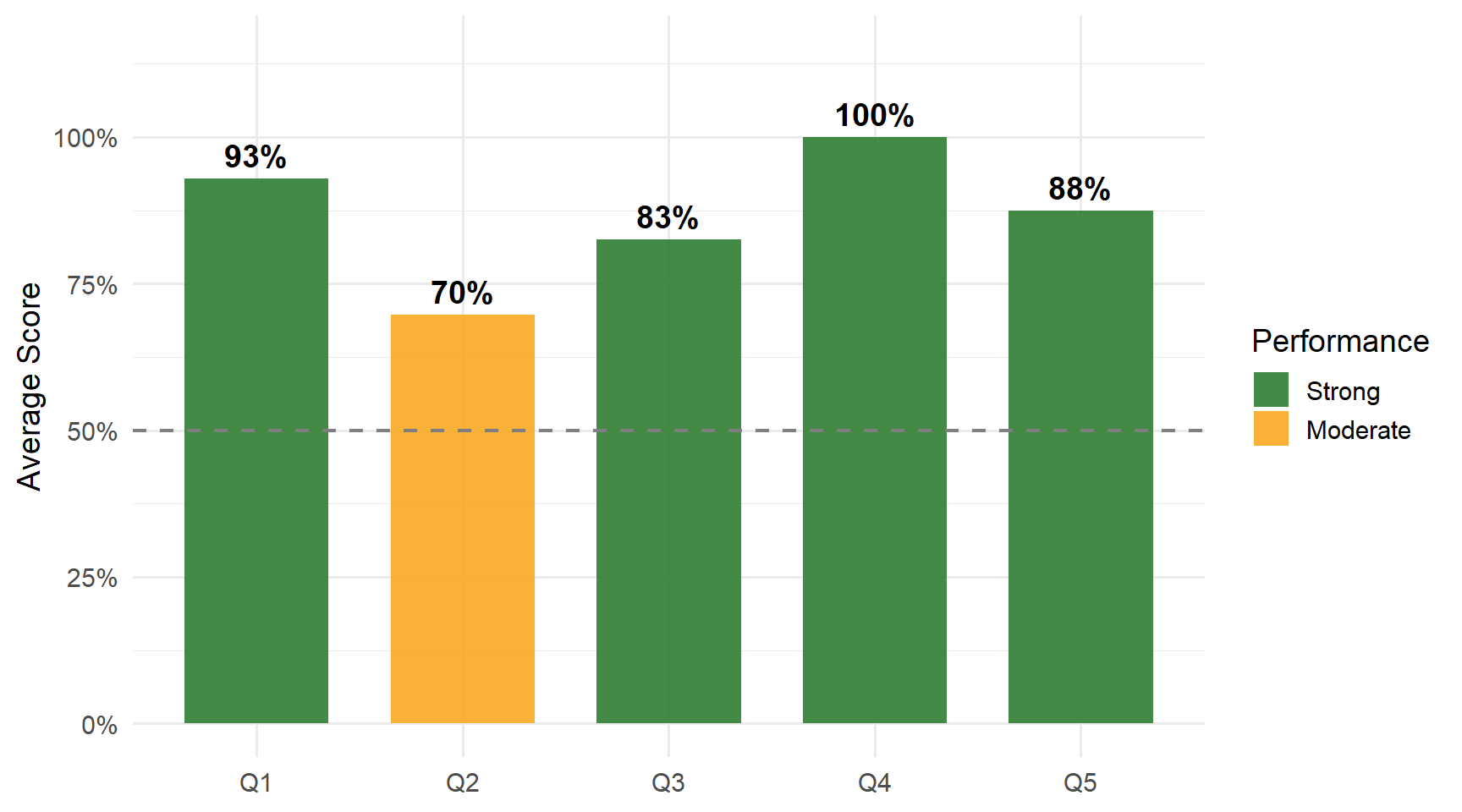
Performance by Question
Questions
Q1: Classification measurement error independence
Correct Answer
The error is not independent of the truth in the classification case — unlike classical measurement error where errors are independent of the true value.
Common Errors
- Writing “is” instead of “is not” — Confusing classification error with classical error. Classification error depends on the true category.
- Left blank — Some students did not provide an answer for this fill-in-the-blank question.
- Adding extra words — Writing phrases beyond “is not” suggests uncertainty about the distinction between error types.
Q2: MCAR assumption — missingness is _____ of analysis variables
Correct Answer
Missingness is independent of the analysis variables (\(Y\) and \(X\)s) under the MCAR assumption.
Common Errors
- Writing “MAR” or “MCAR” — These are assumption names, not what fills the blank. The question asks about the property of missingness.
- Writing “dependent” or “not included” — The opposite of the correct answer. MCAR means missingness does not depend on the variables.
- Writing probability notation or variable names — Answers like “P(si),” “Si = 0,” “Y,” or “Xs” don’t answer the conceptual question.
Q3: Table 4 — wage gap and schooling gap for missing IQ
Correct Answer
Young men with missing IQ scores earn roughly 19–24% lower wages and complete about 2 fewer years of schooling on average.
Common Errors
- Percentage below range (15–18%) — Many students wrote 15%, 17%, or 18%, underestimating the wage gap shown in Table 4.
- Percentage far outside range (5%, 47%) — Calculation errors leading to very different percentages.
- Wrong years of schooling — Writing 1.2, 0.60, or 3 years instead of approximately 2.
Q4: Z is a _____ in the DAG
Correct Answer
\(Z\) is a confounder — it affects both the treatment and the outcome in the DAG illustration.
Common Errors
- Writing “proxy” — A proxy is not the same as a confounder, which directly causes both treatment and outcome.
- Misspellings accepted — “Confound,” “confounding,” “confounding variable,” and similar variants all received full credit.
- Writing “co-founder” — A misreading of “confounder.” The concept refers to a variable that confounds the causal relationship.
Q5: Rate of return to schooling and bias direction
Correct Answer
Figure 2 shows 3.9% return, Figure 3 shows 2.6% after IQ adjustment, indicating the estimate is biased upward.
Common Errors
- Writing “downward” instead of “upward” — The most common error. Since 3.9% drops to 2.6% after adjustment, the original was too high (biased upward).
- Missing the bias direction entirely — Some provided percentages but omitted upward/downward. All three parts are needed.
- Wrong adjusted return — Writing 1.6%, 2.4%, 2.8%, or 6% instead of 2.6%.
Key Takeaways
Strengths: Classification error not independent of truth | Z is a confounder | 3.9% and 2.6% returns widely known.
Review:
- MCAR means “independent” — missingness is independent of analysis variables, not “MAR” or “dependent”
- Table 4 wage gap is 19–24% — not 15% or 17%; review the calculation from Table 4 means
- Bias is upward — the unadjusted estimate (3.9%) is higher than adjusted (2.6%), so the bias goes upward, not downward