Daily 5 - Feb 2
Class Performance
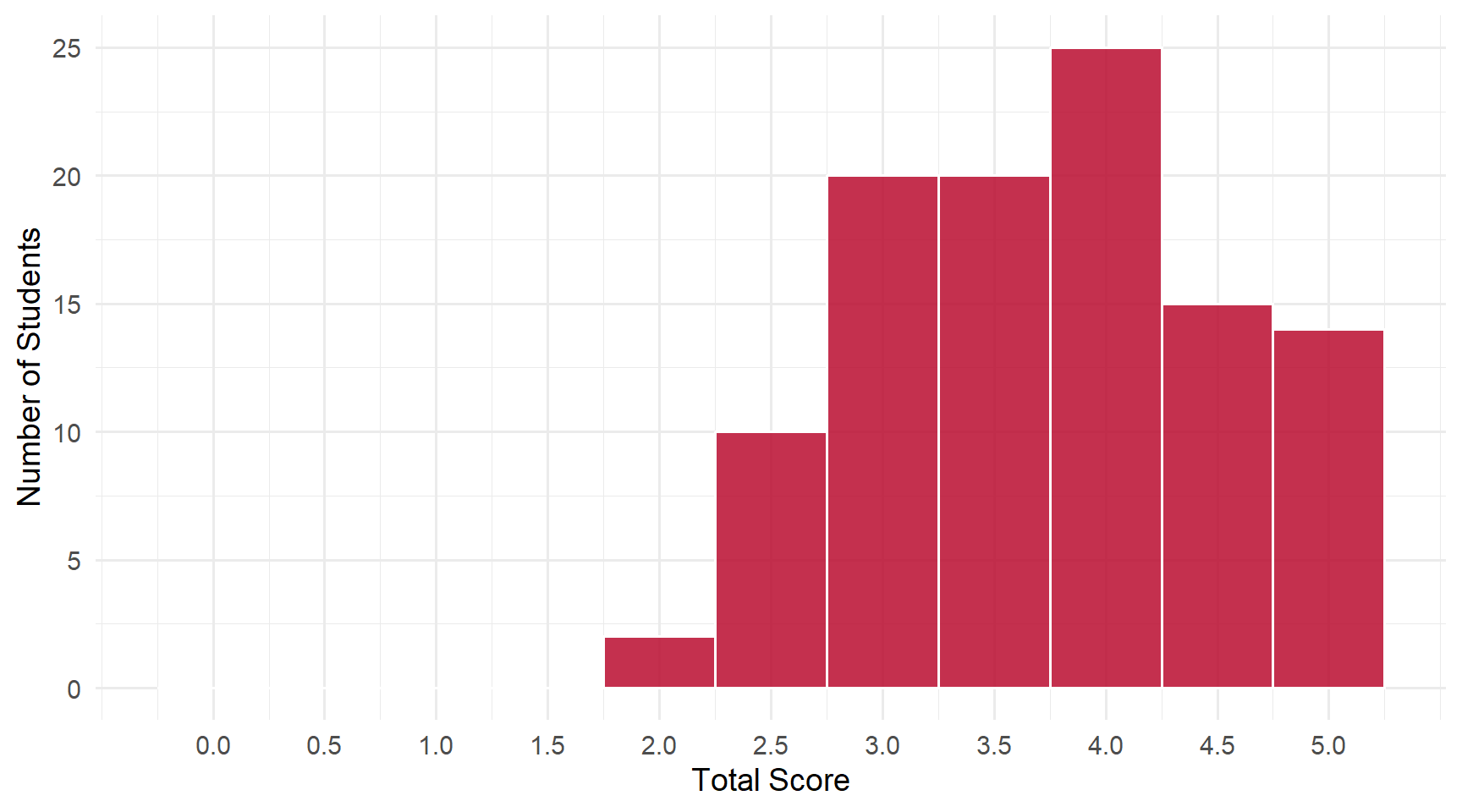
Students: 106 | Mean: 3.74 | Median: 4 | SD: 0.79
Scores ranged from 2 to 5 out of 5 points.
Score Distribution
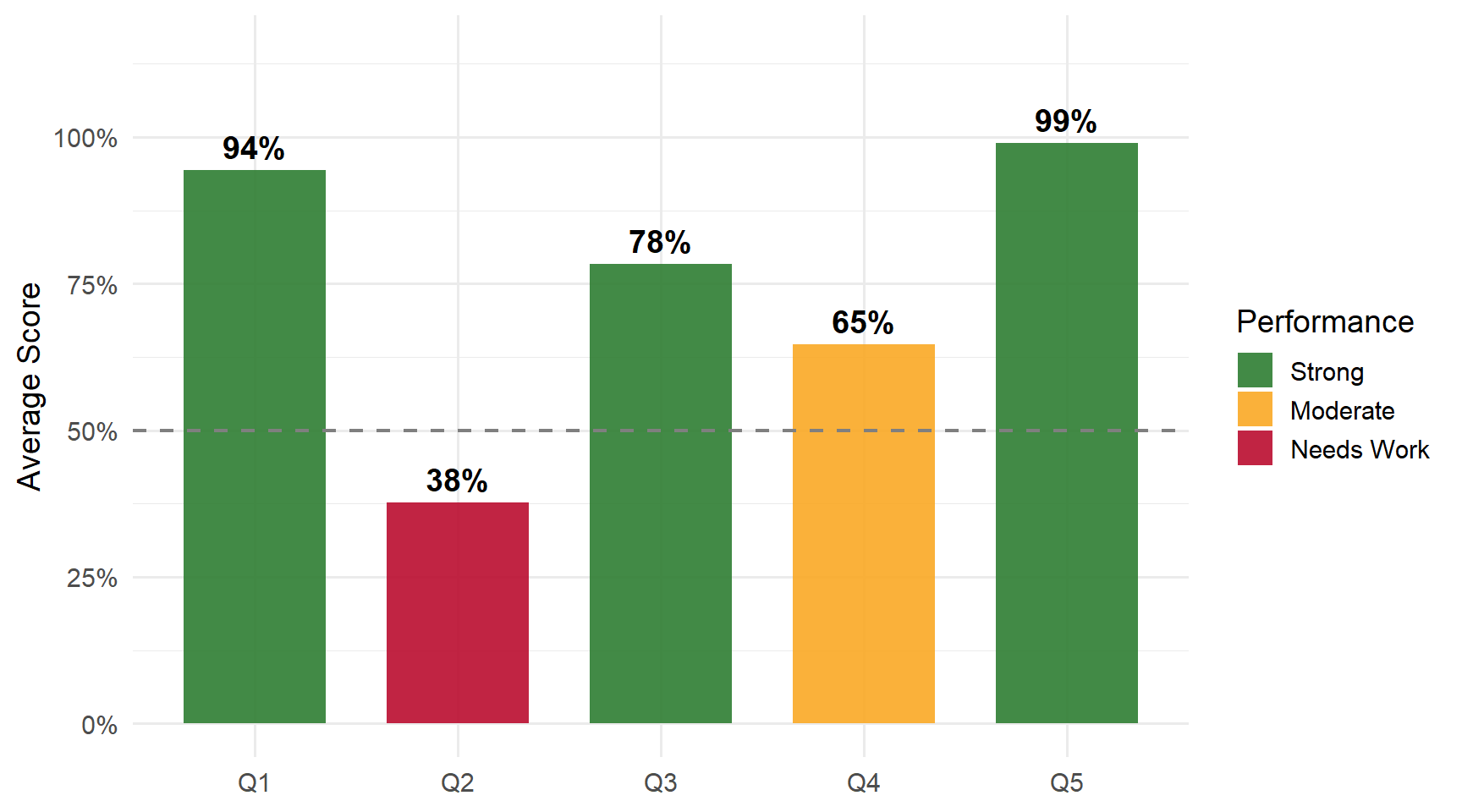
Performance by Question
Questions
Q1: Write the formal definition of expected value
Correct Answer
E(Y) = Σ p_j y_j — The expected value is the sum of each possible value multiplied by its probability.
Common Errors
- Missing summation notation — Writing “p·y” without the Σ symbol. The formula requires summation over all values.
- Wrong operator — Using multiplication (×) instead of summation (Σ) between terms.
- Conceptual only — Describing “weighted average” without writing the mathematical formula requested.
Q2: Write the formal definition of variance
Correct Answer
Var(Y) = Σ p_j(y_j − μ_y)² — The variance is the sum of probability-weighted squared deviations from the mean.
Common Errors
- Wrote expected value instead — Many students repeated the E(Y) formula. Variance measures spread, not center.
- Missing squared term — Writing (y_j − μ) without squaring. The squared term is essential to variance.
- Wrote sample mean formula — Ȳ = (1/n)Σy_i is sample mean, not variance.
- Conceptual description only — “Average distance from mean” is incomplete; variance uses squared deviations.
Q3: The gender wage gap percentage from the Uber study
Correct Answer
7% — The overall gender wage gap documented by the Uber study authors and reported in the Freakonomics podcast.
Common Errors
- Wrong percentages — Common incorrect answers included 8%, 18%, 19%, 25%, 30%, 35%. The exact figure was 7%.
- Confusing with other statistics — Some wrote wage gaps from other studies or contexts.
- Left blank — This was a recall question from the podcast material.
Q4: Explain the filter function without using “filter”
Correct Answer
The code keeps/restricts to individuals where age is between 23 and 62 — selecting working-age adults for the “defining a career” analysis.
Common Errors
- Used prohibited word “filter” — The question specifically asked to explain without using that word. Use “keeps,” “restricts,” or “selects.”
- Vague about age bounds — Saying “restricts by age” without specifying the exact range (23-62).
- Wrong age bounds — Some wrote 26 or 40 as the upper bound instead of 62.
Q5: Random sampling — one draw ___ depend on another
Correct Answer
does not — The key idea behind random sampling is that one draw from the population does not depend on another (independence).
Common Errors
- Very few errors — This was the best-performing question with near-perfect scores.
- Writing “does” instead of “does not” — Random sampling requires observations to be independent.
Key Takeaways
Strengths: Expected value formula, random sampling independence concept, understanding of wage gap research.
Review:
- Variance formula — Var(Y) = Σp_j(y_j − μ)² requires the squared deviation term
- Uber wage gap = 7% — From the Freakonomics podcast assigned listening
- Code interpretation — Be precise about what code does (ages 23-62), and follow question instructions (don’t use prohibited words)