Daily 16 - Mar 23
Class Performance
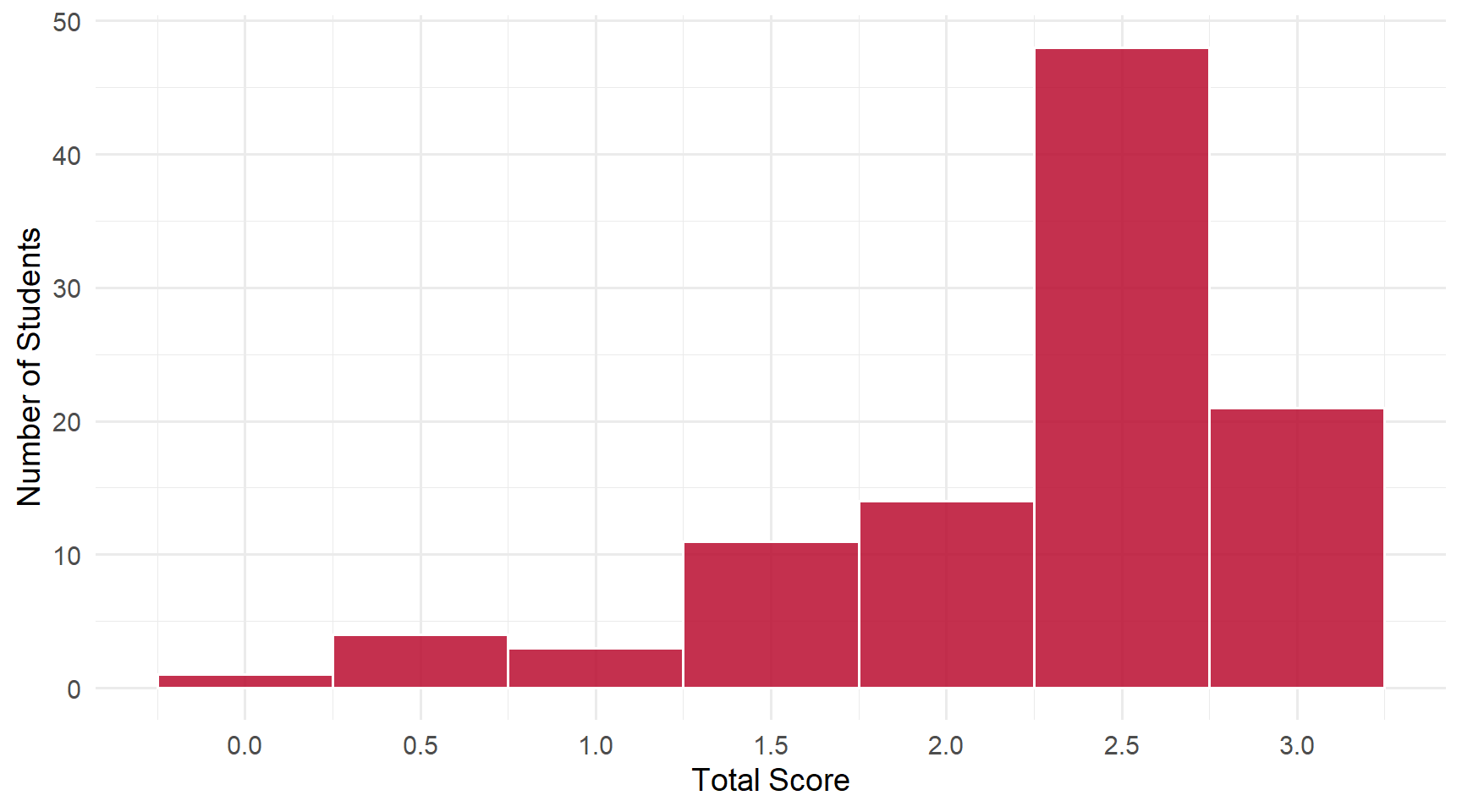
Students: 102 | Mean: 2.28 | Median: 2.5 | SD: 0.66
Scores ranged from 0 to 3 out of 3 points.
Score Distribution
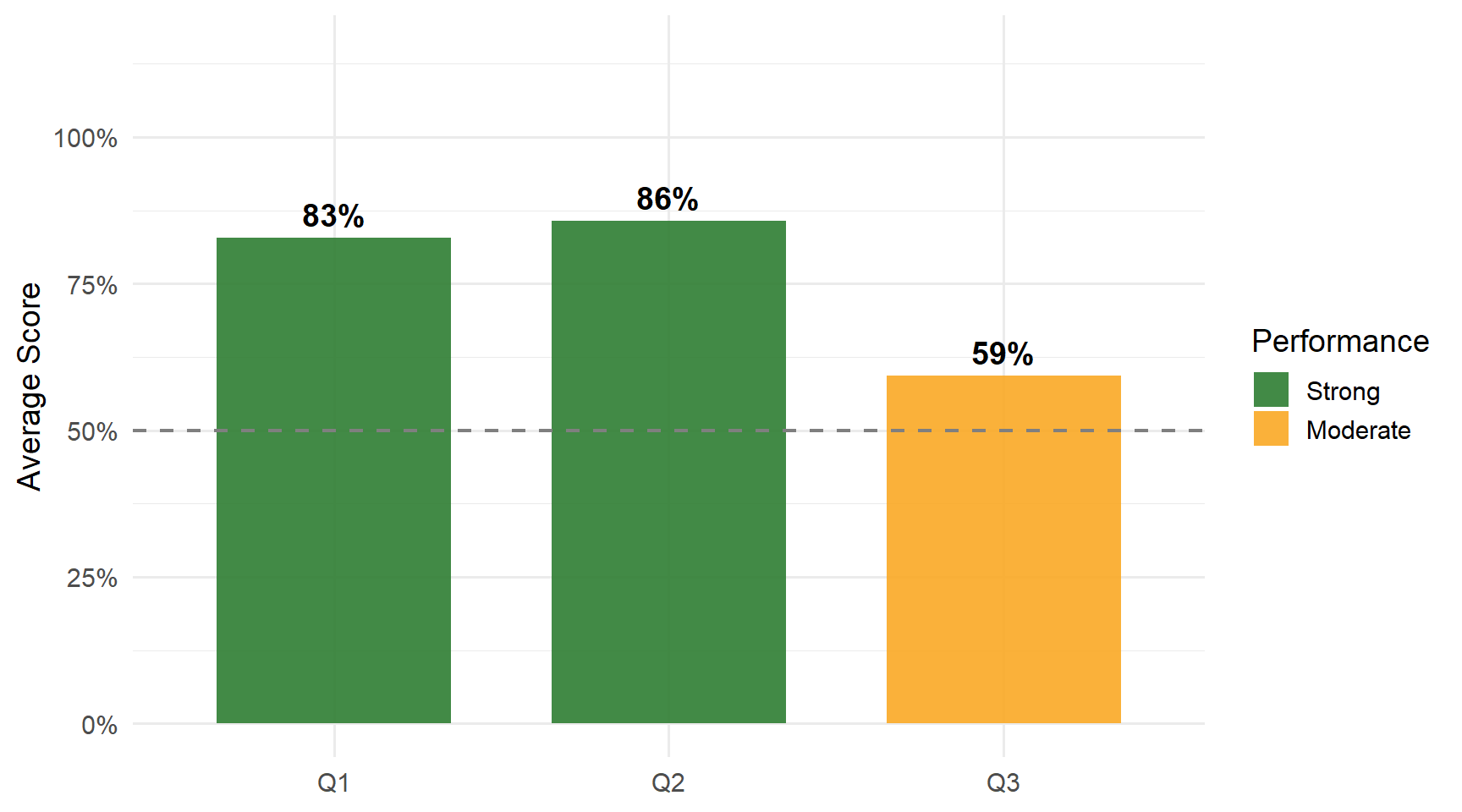
Performance by Question
Questions
Q1: Measurement Error Bias Direction
Correct Answer
Measurement error in x causes the coefficient to be biased toward zero (attenuation bias). Also acceptable: downward.
Common Errors
- Writing “upward” — Measurement error attenuates, it does not inflate.
- Writing “directionally” — Not a meaningful statistical term here. The bias is toward zero.
- Writing “positively” — The direction is toward zero regardless of the true coefficient’s sign.
Q2: t-Statistic Formula (Testing Beta = 1)
Correct Answer
t = (beta-hat - 1) / se(beta-hat) — subtract the null value (1) from the estimate, divide by the standard error.
Common Errors
- Using 0 instead of 1 — The null hypothesis is beta = 1, not beta = 0.
- Using 5 instead of 1 — Some confused the null value.
- Missing the se() denominator — Must divide by the standard error.
Q3: AI Effects on Project Proposal Quality (P&G)
Correct Answer
AI sharply increased standardized quality, more for individuals than teams, placing individuals on par with teams.
Common Errors
- Only noting quality increase — Must also note the differential: AI helped individuals more than teams.
- Reversing the comparison — Some said teams benefited more. The figure shows individuals gained more.
- Too vague — “AI is helpful” or “quality increases” without specifics about individual vs. team effects.
Key Takeaways
Strengths: Attenuation bias mostly understood | t-statistic formula well known.
Review:
- Measurement error → attenuation — Coefficient biased toward zero
- t-test formula — Always subtract the null value: t = (estimate - null) / se
- AI experiment — Individuals gained more from AI than teams; individual+AI matched team+AI