Daily 17 - Mar 25
Class Performance
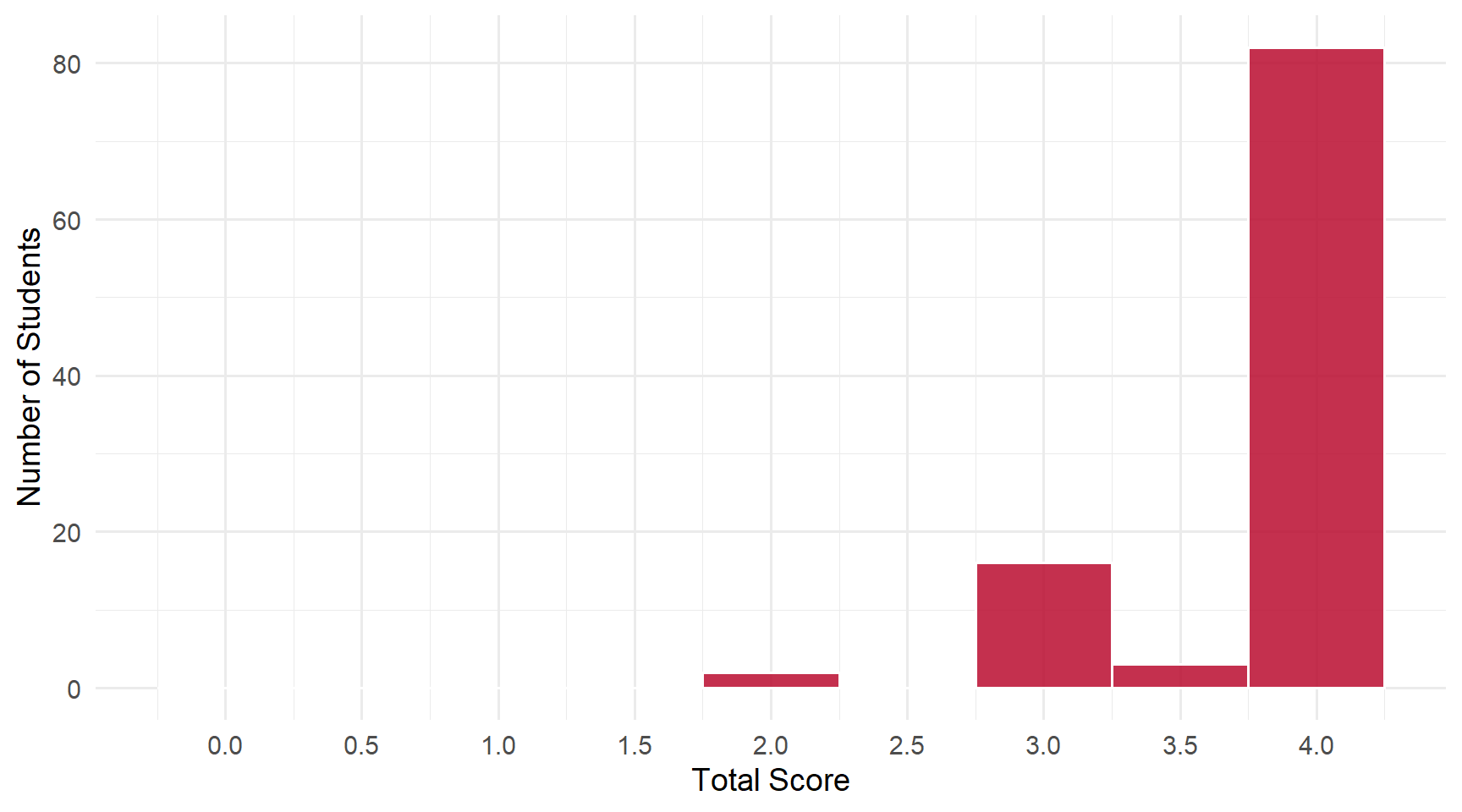
Students: 103 | Mean: 3.79 | Median: 4 | SD: 0.45
Scores ranged from 2 to 4 out of 4 points.
Score Distribution
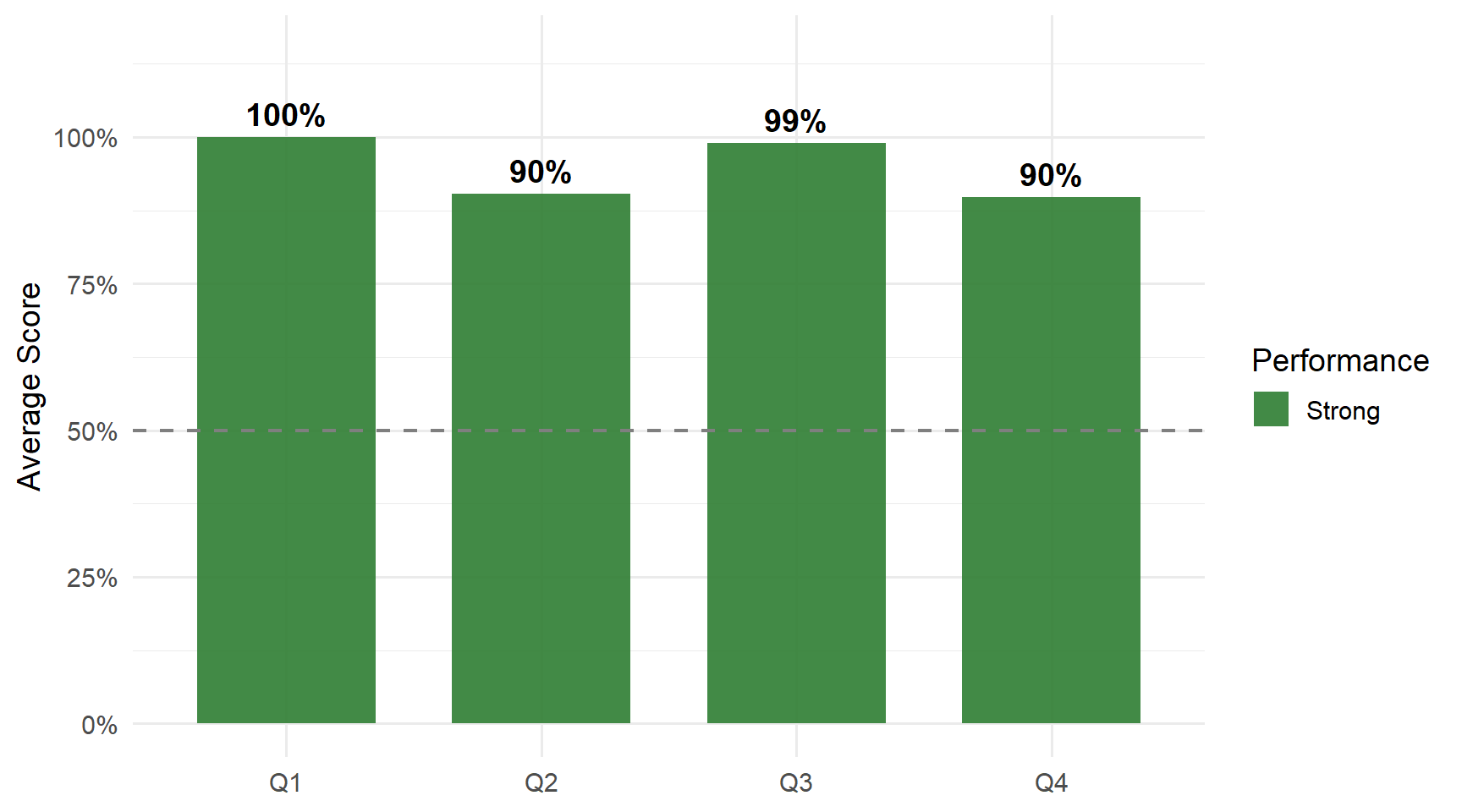
Performance by Question
Questions
Q1: Education Control and Gender Wage Gap
Correct Answer
Controlling for education causes the estimated gender wage gap to rise by about 7 percentage points.
Common Errors
- Very few errors — Nearly all students correctly identified “rise/increase” and “7.”
- Minor variation — Some wrote “7.4” which is also acceptable.
Q2: STAR Small Class Effect
Correct Answer
Students in small classes scored about 14 points higher, and the result is statistically significant.
Common Errors
- Writing “19” — Likely from a different row or specification.
- Writing “5.83” or other wrong values — From different columns.
- Saying “is not” significant — The effect is statistically significant.
Q3: Counterfactual
Correct Answer
Causal inference begins with the notion of a counterfactual — what would happen to the same unit under different conditions.
Common Errors
- Very high performance — Nearly all students correctly wrote “counterfactual.”
- Spelling variations accepted — “Counter factual,” “counter-factual” all received full credit.
Q4: Selection Bias
Correct Answer
Comparing treated and untreated group averages won’t produce the ATE because of selection bias.
Common Errors
- Leaving blank — Several students left this blank.
- Writing “section” or “greater” — These are not the correct term.
Key Takeaways
Strengths: Exceptional performance overall | Counterfactual mastered | Gender wage gap well understood.
Review:
- STAR experiment — Small class effect is about 14 points (statistically significant)
- Selection bias — The reason simple comparisons fail for causal inference
- Counterfactual — The hypothetical “what if” that causal inference tries to estimate