Daily 11 - Feb 23
Class Performance
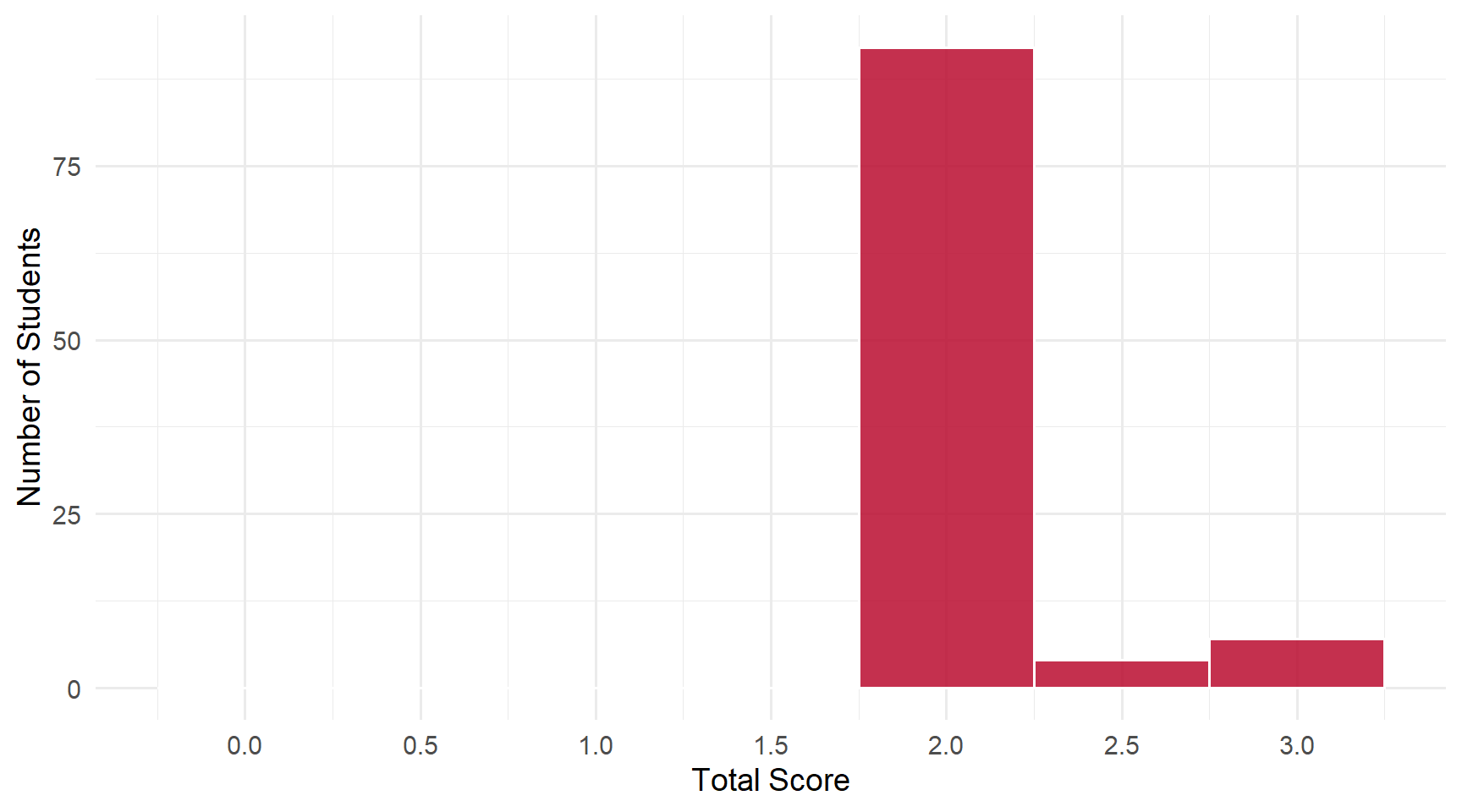
Students: 103 | Mean: 2.09 | Median: 2 | SD: 0.27
Scores ranged from 2 to 3 out of 3 points.
Score Distribution
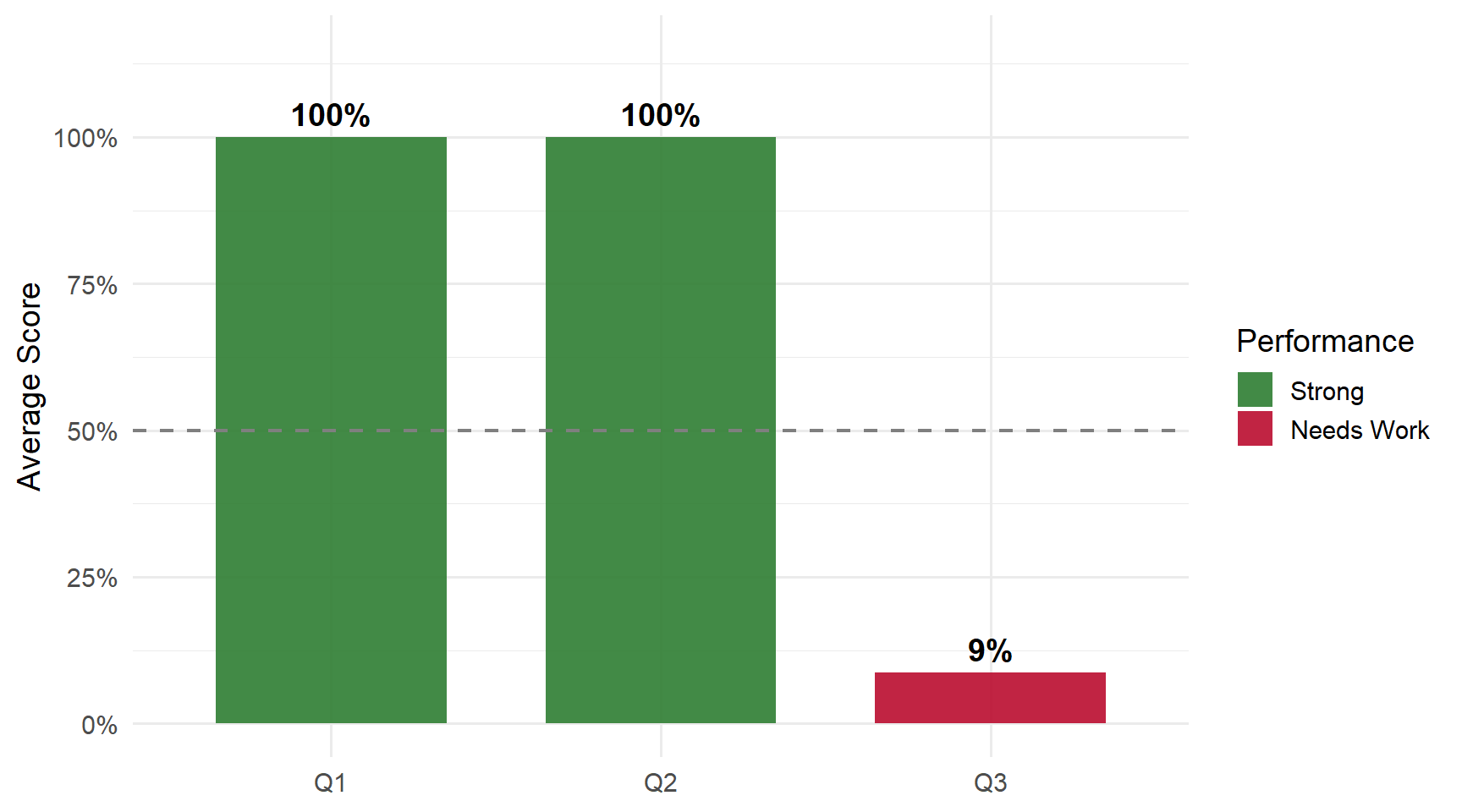
Performance by Question
Questions
Q1: What is the prior, P(H)?
Correct Answer
P(H) = 30% (0.30) — the base rate of spam emails before seeing any evidence from the filter.
Common Errors
- Blank/no answer — A small number of students left this blank. The prior is the initial probability before observing new evidence.
- Confusing prior with likelihood — Writing 90% (the filter’s detection rate) instead of the base rate of spam.
- Confusing prior with false positive rate — Writing 10% (P(E|~H)) instead of the prior probability of the hypothesis.
Q2: What is the likelihood, P(E|H)?
Correct Answer
P(E|H) = 90% (0.90) — the probability the filter flags an email as spam given that it actually is spam.
Common Errors
- Blank/no answer — A small number of students left this blank. The likelihood is the probability of observing the evidence given the hypothesis is true.
- Confusing likelihood with prior — Writing 30% (the base rate) instead of the filter’s detection rate.
- Confusing with false positive rate — Writing 10%, which is P(E|~H), the probability of flagging a legitimate email.
Q3: Calculate the posterior, P(H|E)
Correct Answer
P(H|E) = P(E|H)P(H) / [P(E|H)P(H) + P(E|H)P(H)] = (0.9 x 0.3) / (0.9 x 0.3 + 0.1 x 0.7) = 0.27 / 0.34 = 0.79 (79%)
Common Errors
- App default answer (~16.1%) — The most common error by far. Many students submitted the Bayes Rule app’s default/previous example answer instead of recalculating for this specific problem.
- Numerator only (27%) — Some students calculated P(E|H) x P(H) = 0.27 but did not divide by the total probability P(E) in the denominator.
- Other component values — Some wrote the false positive rate (10%), the likelihood (90%), or other intermediate values instead of the full Bayes Rule calculation.
Key Takeaways
Strengths: Strong identification of prior P(H) = 30% | Likelihood P(E|H) = 90% correctly identified by nearly all students.
Review:
- Always recalculate in the app — The Bayes Rule app retains previous answers; make sure to update all inputs before recording the posterior
- Bayes Rule formula: P(H|E) = P(E|H)P(H) / [P(E|H)P(H) + P(E|H)P(H)]
- For this problem: (0.9 x 0.3) / (0.9 x 0.3 + 0.1 x 0.7) = 0.27 / 0.34 = 0.79