Daily 18 - Mar 30
Class Performance
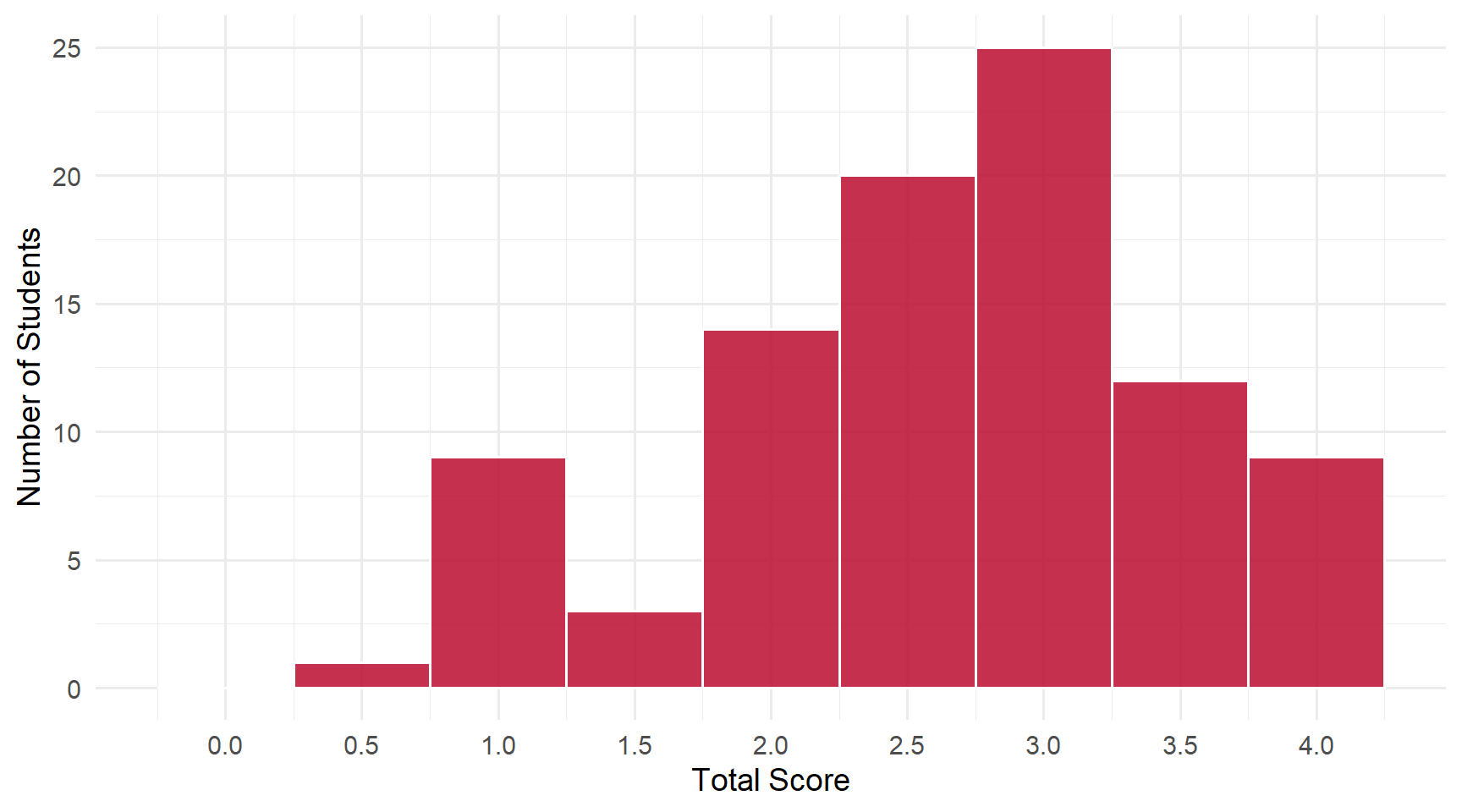
Students: 93 | Mean: 2.63 | Median: 2.5 | SD: 0.86
Scores ranged from 0.5 to 4 out of 4 points.
Score Distribution
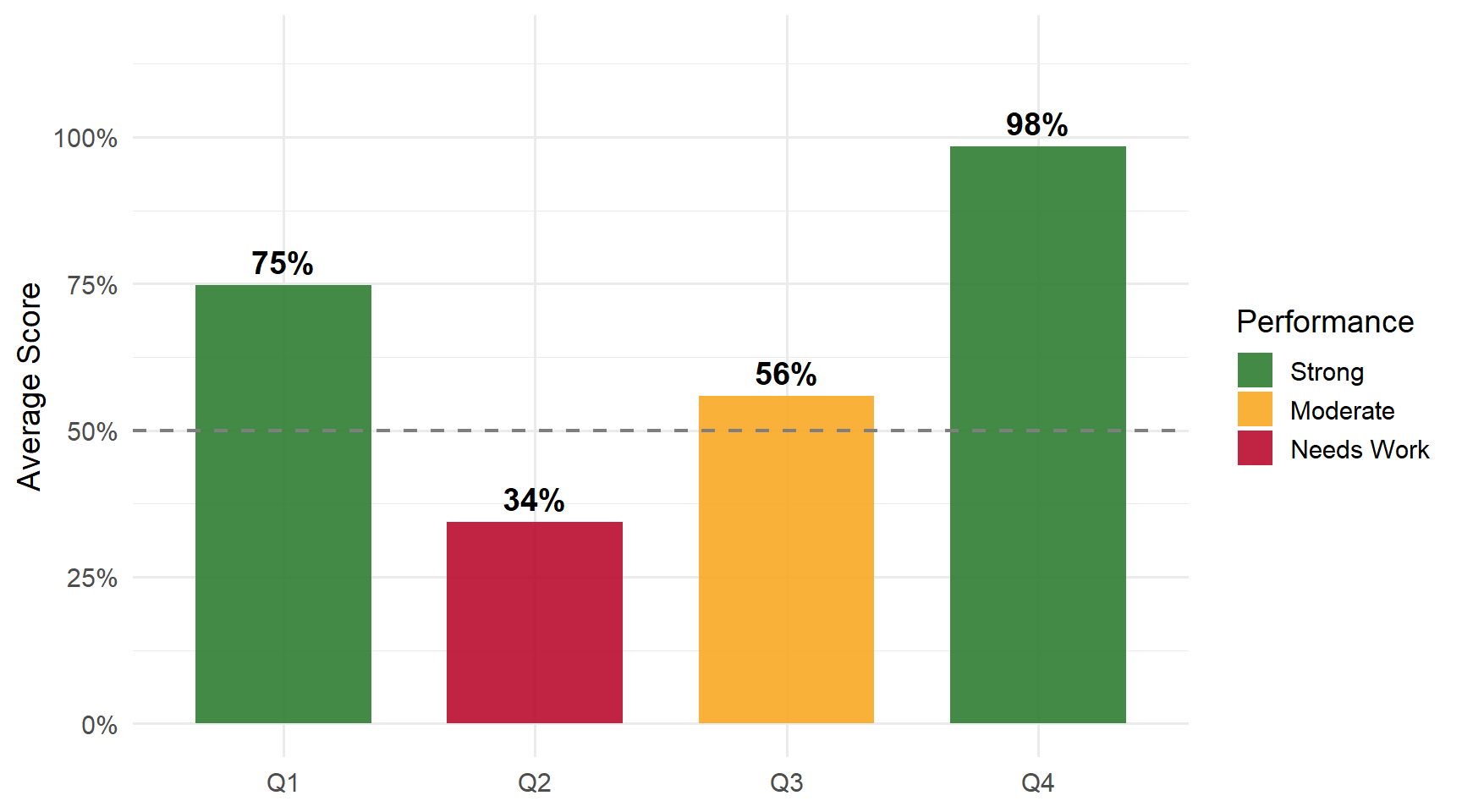
Performance by Question
Questions
Q1: Demographic Controls and Gender Wage Gap
Correct Answer
Adding demographic controls explains a small fraction of the gender wage gap.
Common Errors
- Writing “large” — Many students said “large,” but Column 3 shows demographics explain very little.
- Confusing significance with explanatory power — Statistically significant controls don’t necessarily explain a large fraction.
Q2: Team+AI vs Individual+AI Speed Difference
Correct Answer
Team+AI groups are 5 percentage points slower than Individual+AI groups.
Common Errors
- Using “log time” or “hours” — Many wrote “0.048 log time.” The answer is 5 percentage points.
- Writing “4.8” without units — Close value but must specify percentage points.
- Writing in minutes or seconds — The table reports percentage point differences.
Q3: Small Class Equivalent Years of Experience
Correct Answer
Being in a small class is equivalent to a teacher with 10 more years of experience.
Common Errors
- Wrong values (1.5, 2, 3, 7, 14, 21) — Divide small class effect by the experience coefficient.
- Close values (9, 9.5) — Approximately correct, received partial credit.
Q4: Randomization and the CIA
Correct Answer
Randomization makes potential outcomes independent of treatment. Without an RCT, the CIA (Conditional Independence Assumption) must hold.
Common Errors
- Missing CIA — Some wrote “independent” but omitted the second term.
- Writing “CSA” or “selection” — The correct abbreviation is CIA.
Key Takeaways
Strengths: CIA concept well understood | Independence from randomization clear.
Review:
- Demographics explain little of the gender wage gap
- Read table units carefully — “5 percentage points” not “0.048 log time”
- Small class ≈ 10 years experience — Divide class size effect by experience coefficient