Daily 25 - Apr 27
Class Performance
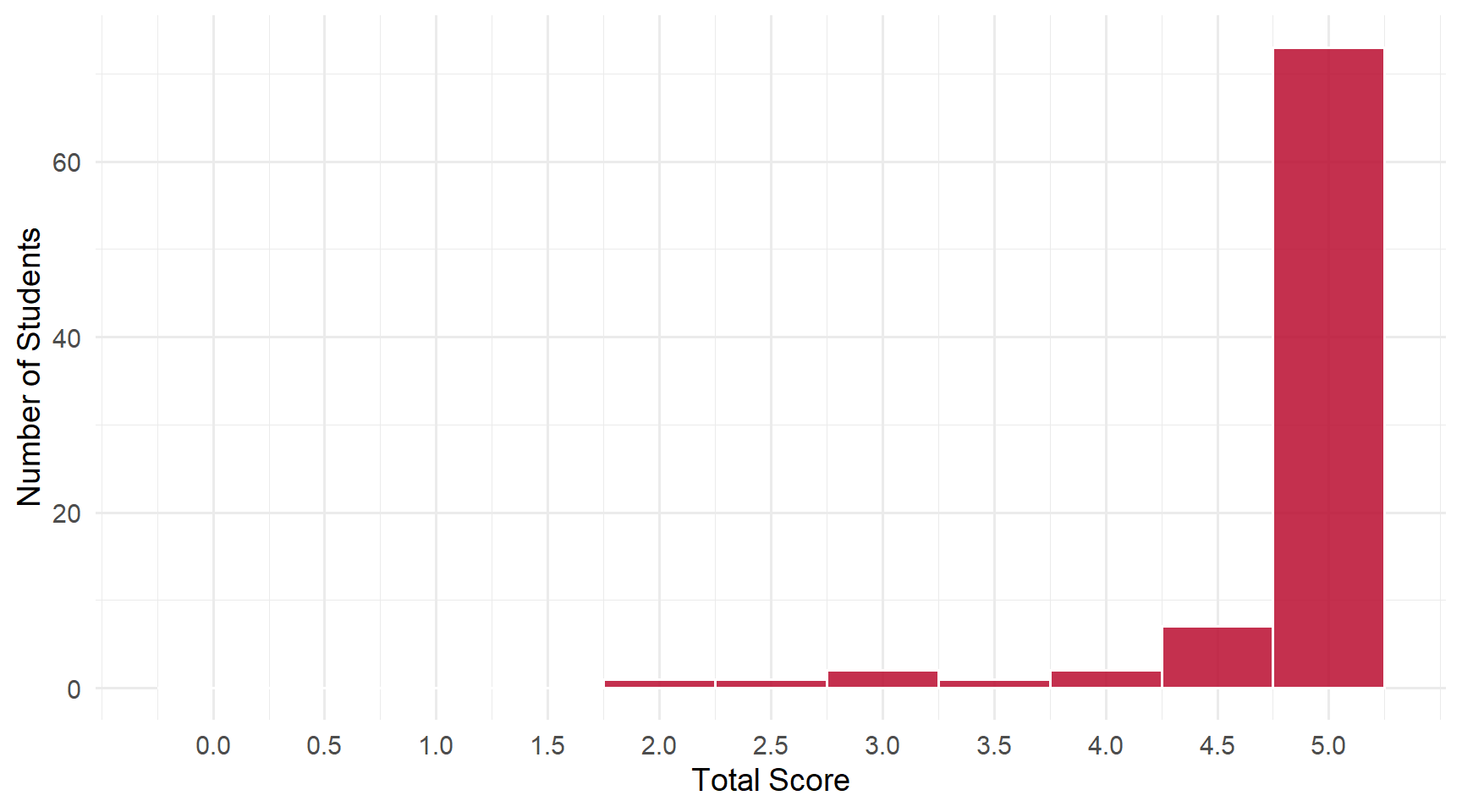
Students: 87 | Mean: 4.81 | Median: 5 | SD: 0.55
Scores ranged from 2 to 5 out of 5 points.
Score Distribution
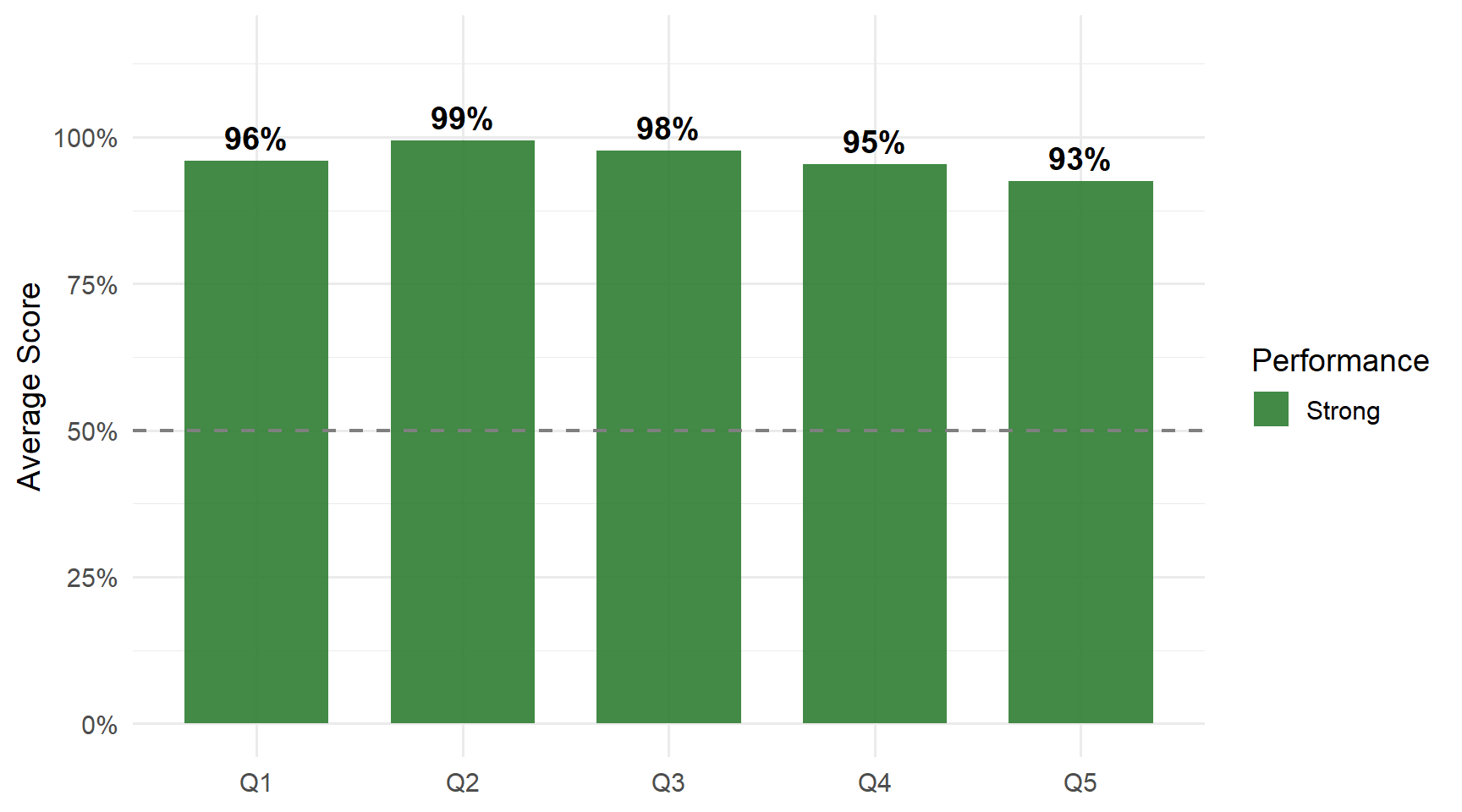
Performance by Question
Questions
Q1: LASSO Penalty Effect and λ
Correct Answer
The LASSO penalty shrinks the OLS coefficients toward zero. The purpose of \(\lambda\) is to tune the strength of the penalty.
Common Errors
- “Controls” / “adjusts” for tune — Accepted.
- “Push” / “drive” for shrink — Accepted as equivalent.
- Reversed answers — Half credit if both concepts present but slotted in the wrong blanks.
Q2: First Dotted Line in CV Plot
Correct Answer
The first vertical dotted line marks the LASSO specification that minimizes MSPE (mean squared prediction error) in cross-validation.
Common Errors
- “MSE” / “mean squared error” — Accepted as equivalent shorthand.
- “R-squared” / “deviance” — Wrong loss function for the CV minimization shown.
Q3: LASSO Retained 52 Coefficients
Correct Answer
LASSO retained 52 coefficients (features) at the optimal \(\lambda\).
Common Errors
- 51 or 53 — Accepted (close enough).
- Wildly off (e.g., 6, 100) — Zero credit.
Q4: LPM Coefficient on Years of Education
Correct Answer
Another year of education increases the likelihood of being in the labor force by 3.8 percentage points.
Common Errors
- “3.8” without units — Half credit. Always state the units.
- “3.8%” — Half credit. LPM coefficients are in probability units; “percentage points” is the precise label.
- Wildly different number (e.g., 0.38, 38) — Zero credit.
Q5: Predicted Probabilities — Logistic vs LPM
Correct Answer
Logistic predicted probability = .95; LPM predicted probability = 1.04 (which is impossible, illustrating LPM’s main weakness).
Common Errors
- “95%, 1.04” — Full credit. Same numerical values, just expressed as a percentage.
- One of two correct — Half credit; most often students nailed .95 but missed 1.04.
- Negative or wildly different values — Zero credit.
Key Takeaways
Strengths: LASSO mechanics solid | CV interpretation clear | LPM vs logistic comparison understood.
Review:
- LASSO terminology — \(\lambda\) tunes; the penalty shrinks; selection is the side-effect
- LPM units — Coefficients are in percentage points (probability units), not %
- Why we use logistic — LPM can predict probabilities outside [0, 1], like the 1.04 case here