Daily 21 - Apr 08
Class Performance
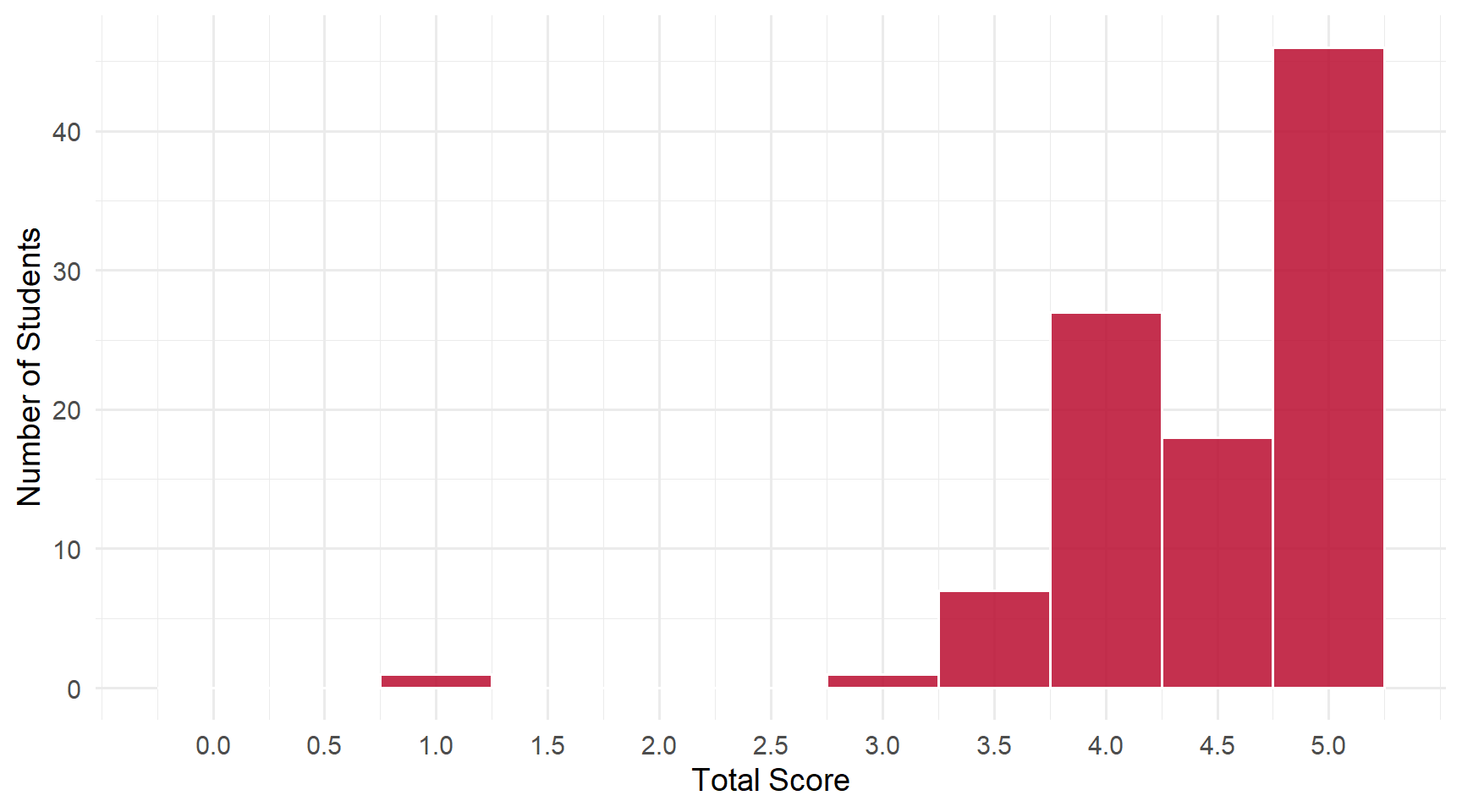
Students: 100 | Mean: 4.47 | Median: 4.5 | SD: 0.63
Scores ranged from 1 to 5 out of 5 points.
Score Distribution
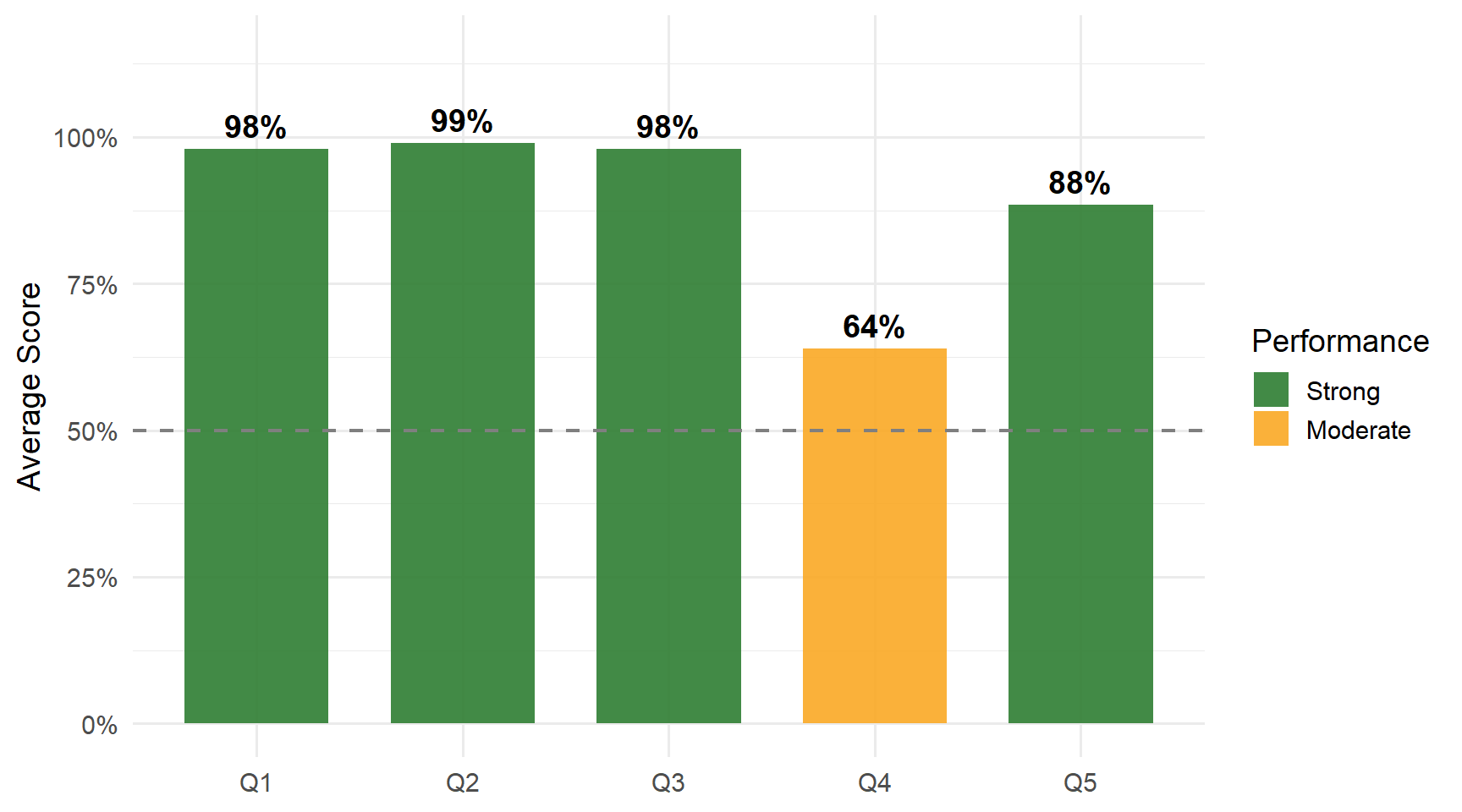
Performance by Question
Questions
Q1: DD Identifies ATT Under Parallel Trends
Correct Answer
The DD from log duration identifies the ATT if high and low earners followed parallel trends in the absence of the WBA cap increase.
Common Errors
- Writing “PTA” — Half credit: shows understanding of the parallel trends assumption but isn’t the literal word.
- Writing “ATE” — DD identifies the ATT (treatment effect on the treated), not the ATE.
Q2: Before/After Comparisons Fail Due To Confounding
Correct Answer
Simple before/after comparisons fail to account for confounding trends in the outcome.
Common Errors
- Writing “time” trends — Related but misses the point; “confounding” captures why simple comparisons fail.
- Near-universal success otherwise.
Q3: Treated-vs-Control Comparisons Fail Due To Confounding
Correct Answer
Simple treated vs control comparisons fail to account for confounding differences between groups.
Common Errors
- Writing “group” differences — Not specific enough; the key concept is confounding.
- Excellent overall performance — Most students understood this.
Q4: Pre-Period Gap in KY (High vs Low Earners)
Correct Answer
In KY, high earners injured before the WBA cap increase were out of work 25.6% longer than lower earners.
Common Errors
- Writing “26” or “25” — Close but missed the decimal place.
- Writing “1.6” or “1.1” — Confused absolute coefficient with percentage longer.
- Writing “70” or “80” — Misread row or column in Table 2.
Q5: MI Effect for High Earners
Correct Answer
The MI WBA cap increase caused high earners to be out of work 19–20% longer, but the result is not statistically significant.
Common Errors
- Writing just “not” — Half credit: prompt specifies “(is/is not)” — full phrase is “is not.”
- Writing “is significant” — Incorrect; SE is too large relative to estimate.
Key Takeaways
Strengths: ATT + parallel trends terminology mastered | Confounding concept strong | DD identification logic internalized.
Review:
- Q4 precision — Report the pre-period gap as 25.6% (one decimal)
- Q5 phrasing — “Is not” requires both words; match the (is/is not) prompt exactly
- DD interpretation — MI effect ~19–20% but not statistically significant