Daily 22 - Apr 13
Class Performance
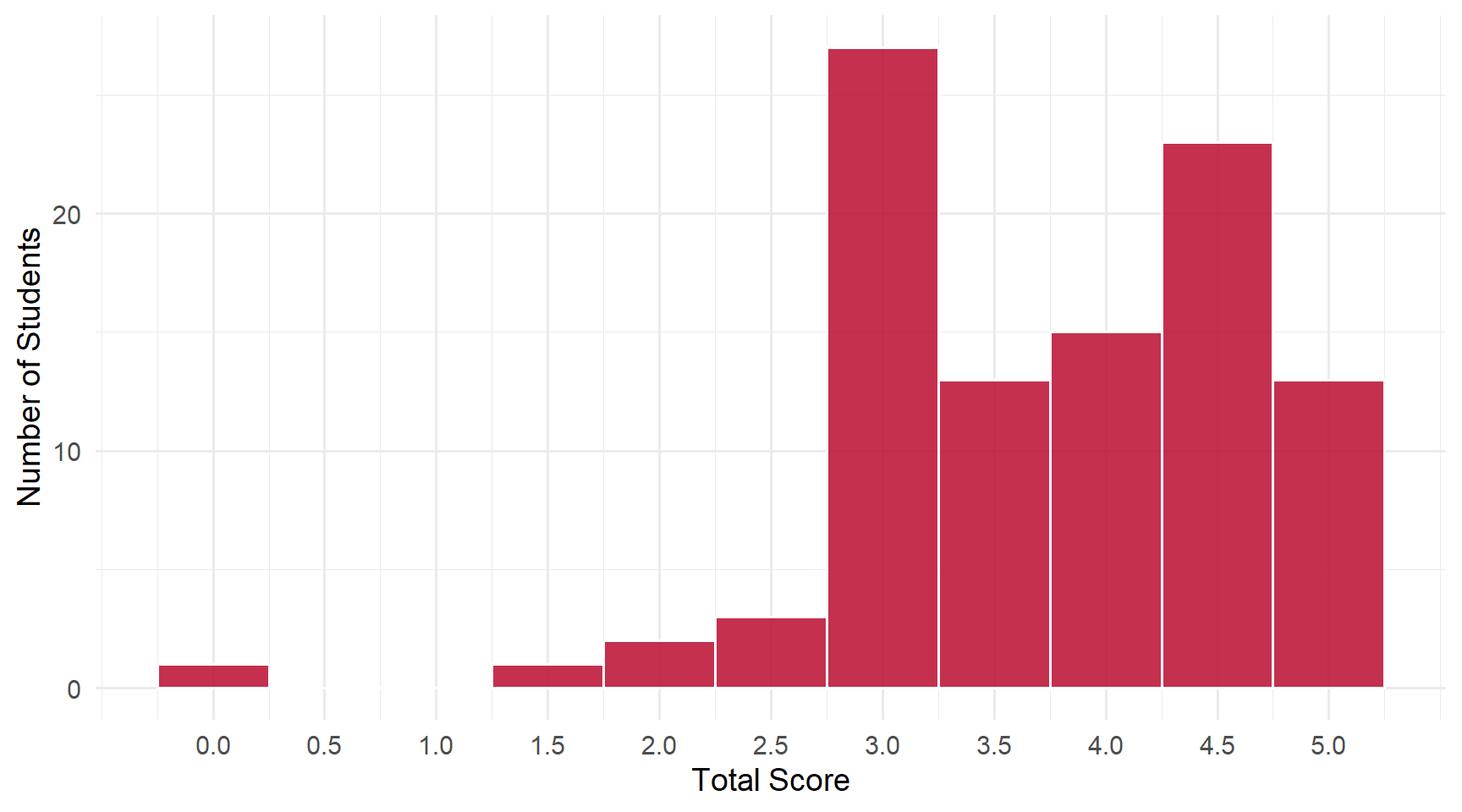
Students: 98 | Mean: 3.76 | Median: 4 | SD: 0.91
Scores ranged from 0 to 5 out of 5 points.
Score Distribution
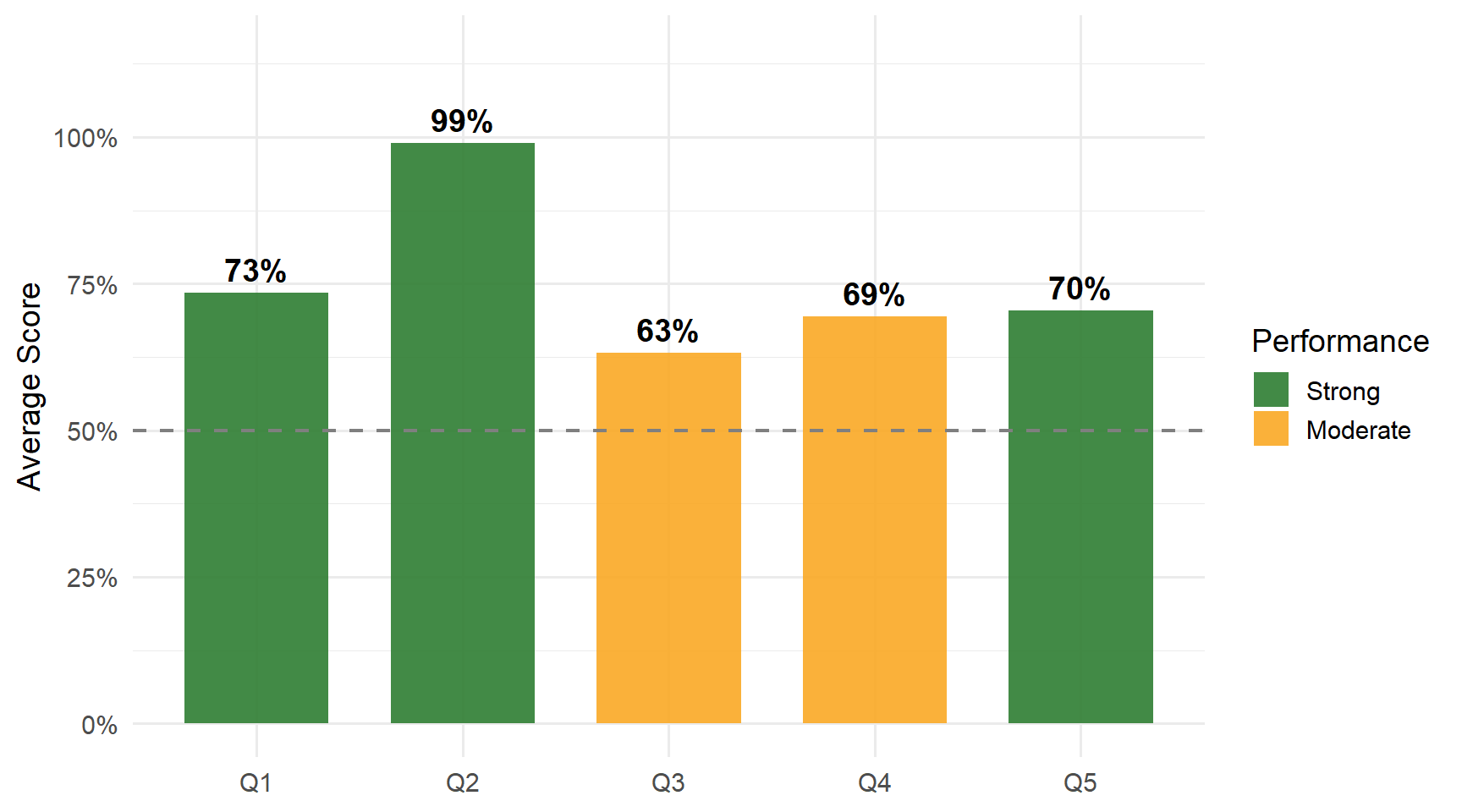
Performance by Question
Questions
Q1: Controls Do NOT Change the KY DD Story
Correct Answer
False. Adding controls to the baseline DD for KY does not substantially reduce the WBA effect on injury duration nor render it statistically insignificant.
Common Errors
- Writing “True” — Common misread; controls typically refine rather than reverse DD estimates here.
- Intuition — DD already differences out time-invariant group differences; controls mostly tighten SEs.
Q2: PTA in Multi-Group DD
Correct Answer
PTA means untreated potential outcome depends only on group and time period differences.
Common Errors
- Writing “unit” or “individual” — Close but PTA is stated in terms of group-level fixed effects.
- Near-universal success on this item.
Q3: Robust SEs = Clustering
Correct Answer
Robust SEs in a multi-group DD means clustering at the group level.
Common Errors
- Writing “cluster” or “to cluster” — Half credit: right concept, wrong form. The term of art is “clustering.”
- Writing “grouping” — Not the standard term.
Q4: t-Statistic for UNITSF Coefficient
Correct Answer
\(t = (51.63 - 50) / 1.874 \approx 0.87\). Plug in the point estimate, hypothesized value, and reported SE.
Common Errors
- Right structure, wrong numbers — Partial credit when the (coef − 50)/SE structure is correct but the specific values are mis-transcribed.
- Using SE(UNITSF) notation only — Half credit: failed to plug in 1.874.
- Inverting the formula — SE/(coef − 50) gets zero; t-stat is (estimate − null) / SE.
Q5: Reject or Fail to Reject?
Correct Answer
Fail to reject the null. With |t| ≈ 0.87 (well below 1.96), we have no evidence against H0: UNITSF = 50.
Common Errors
- Writing “reject” — Wrong direction; a small t-stat means we cannot distinguish the estimate from 50.
- Blank / ambiguous answers — A clear “fail to reject” statement was expected.
Key Takeaways
Strengths: PTA definition solid | Clustering concept understood | Hypothesis-test structure recognized.
Review:
- Q1 intuition — Controls refine DD estimates; they rarely wipe out a robust treatment effect in KY
- Q3 precision — Use “clustering” (gerund), not “cluster”
- Q4 → Q5 logic — Compute t, compare to 1.96, then state reject / fail to reject