Daily 13 - Mar 04
Class Performance
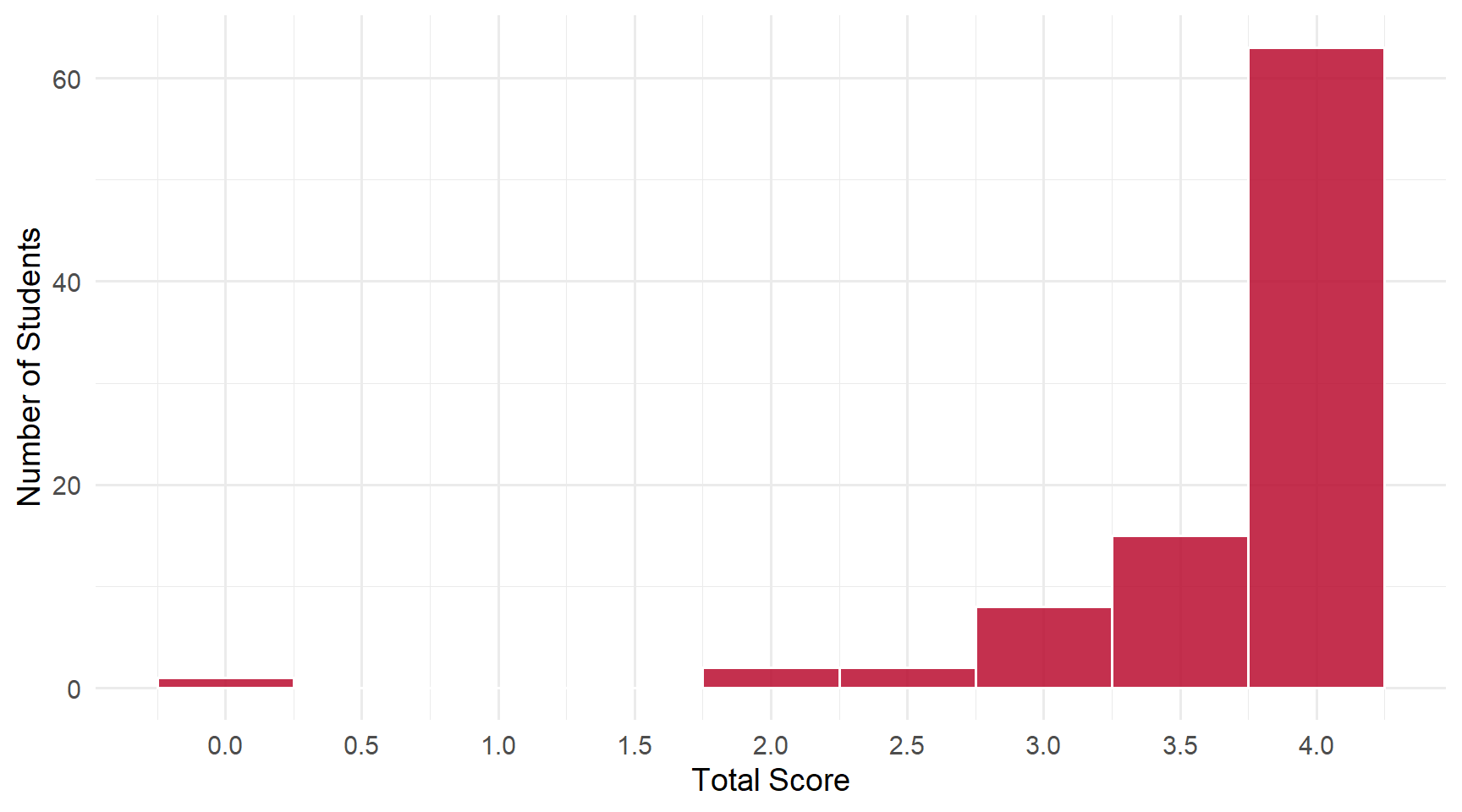
Students: 91 | Mean: 3.71 | Median: 4 | SD: 0.60
Scores ranged from 0 to 4 out of 4 points.
Score Distribution
Performance by Question
Questions
Q1: Unconditional vs. Conditional Expectation
Correct Answer
The unconditional expectation of y is a constant, while the conditional expectation of y given x is a function of x.
Common Errors
- Writing “function” for the first blank — Several students wrote “function” instead of “constant.” The unconditional expectation E[Y] is a single number (constant), not a function.
- Using notation instead of key terms — Some students wrote E(Y) and E(Y|X) rather than stating “constant” and “x.” The question asks what these objects are, not their notation.
- Unclear or swapped blanks — A few students wrote vague letters (N, M) or provided the same answer for both blanks without distinguishing constant from function of x.
Q2: Average Return to Schooling
Correct Answer
The average return to another year of schooling is 5.2 (equivalently 5.21%, 0.0521, or 0.052).
Common Errors
- Providing a formula instead of a number — One student wrote a fraction expression rather than the numeric value from Figure 6.
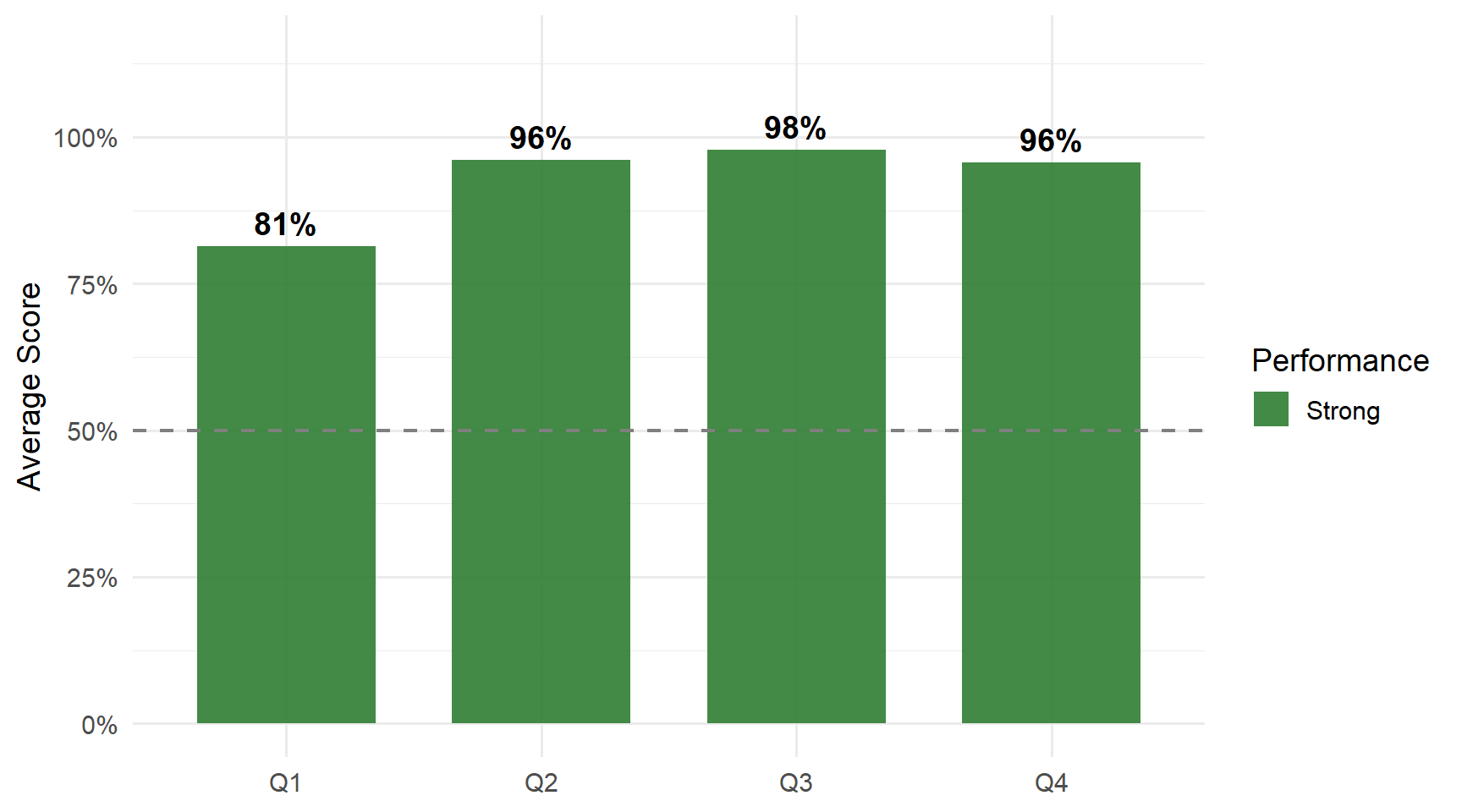
- No widespread errors — The vast majority of students correctly identified the 5.2% return from Figure 6. This was the strongest question overall.
- Rounding differences — Some students wrote 5.2, others 5.21 or 5.21%. All equivalent representations were accepted.
Q3: Statistical Significance
Correct Answer
The estimated return to schooling is statistically significant at the 5% level.
Common Errors
- No common errors — Nearly all students correctly identified “is” as the answer. This was the highest-scoring question.
- Elaborating beyond the answer — Some students added extra context (e.g., “yes, both are significant”). As long as “is” was clearly indicated, full credit was awarded.
Q4: Population Regression Coefficients
Correct Answer
The population regression coefficients minimize the MSE (mean squared error) between the outcome and the regression approximation.
Common Errors
- Writing “mean standard error” — One student confused “squared” with “standard.” MSE stands for mean squared error, not mean standard error.
- Writing incorrect abbreviations — A few students wrote abbreviations that did not match MSE, likely due to handwriting confusion or misremembering the term.
- Writing “measurement square error” — One student used the wrong first word. The correct term is specifically “mean squared error.”
Key Takeaways
Strengths: Return to schooling (5.2%) identified correctly | Statistical significance well understood | MSE widely known.
Review:
- Unconditional expectation is a constant, conditional expectation is a function of x — know the distinction
- MSE = mean squared error — not “mean standard error” or other variations
- State the concept, not just the notation — writing E(Y) doesn’t convey “constant”; say what it is